


Before I take you down the winding path of this article, let’s play a game.
When I say “go,” I want you to close your eyes for 10 seconds… and think of everything that comes to mind when I say learning.
I’m doing this partially because I want to see if your initial thoughts are the same as mine (if you’ll be willing to share!), and partially because, heads up - this article might be a bit long. So this is how I’m getting you to buckle in.
Ready?
.
.
.
Set?
.
.
.
GO! (no peeking, 10 seconds on the clock…)
.
.
.
.
.
.
.
.
.
.
Did you do it? If not, stop scrolling!!
If so, maybe write down what you thought.
(but, ya know, I’m not your mother or your teacher so do whatever you want)
Then proceed.
.
.
.
.
.
.
.
.
.
.
.
.
.
.
.
.
.
.
.
.
Now - I feel it’s only fair that, if I’m going to be asking you to share what came up for you, that I’d be willing to share what comes up for me.
Maryjane shoes.
Tweed jackets.
Ancient buildings.
Medieval universities.
Autumn leaves falling in a gentle breeze.
A stack full of old, leather-bound books.
Notebooks full of doodles.
And with a modern twist, a tablet with highlight annotations.
As it turns out, somewhere and somehow in my mind, I decided (albeit subconsciously) that learning equates to dark academia… a fashion & decoration style loosely based on what people have worn to university for decades (if not centuries).
Here’s a screenshot of what comes up on Pinterest for me when I search dark academia:

And if you’re anything like me?
You love this.
Maybe a part of you even wishes that you dressed like this, or that your life would look something like this.
Hell, maybe your life even does look like this.
This recognition of my own line of thinking, got me thinking:
Has learning become an aesthetic?
Have I somehow, subconsciously decided that this style = well-read? Better education? More intelligent? Authentic intellectualism?
Could it be that the reason people are pursuing aspects of this life (maybe even me included), is because we’re pursuing what we think this life looks like, instead of what it actually does look like?
Or, is this an authentic outward expression of a culture and lifestyle that’s too big and complex to put into a single box or outfit?
Maybe you’ve wondered the same.
I’m in the travel industry, and I believe that traveling to a place really helps you better understand and appreciate it.
I see the glamor and I get it.
But the truth is, in any kind work - including work you do as a historian - you know the daily reality is usually much quieter, less polished, and often less pretty and “aesthetic.”
This is one of the reasons I’ve called my brand/blog/whatever-this-is Everyday Historian.
Because I want to show people what the everyday does and could look like.
Let’s go down this rabbit hole together.
🕳️🐇🐇 ← you and me as bunnies
The Glamor VS. The Grind
Thinking back, I actually learned this lesson as an 18-year-old fresh out of high school.
See, even though I work in the travel industry now as a travel blogger, trip host, tour guide and creator, that’s definitely not where I started.
20 years ago as of when I’m writing this, I was studying music at a community college in Southern California.
Whenever I’d tell someone my major, they’d say something along the lines of, “Oh, you chose an EASY major; I wish I could have as much fun with my engineering/business/chemistry/insert-whatever-other-major here.”
…and anyone who’s reading this who’s been a music major just let out a guffaw because it is NOT AN EASY major.
There was the pretty part that everyone saw:
Opera arias
Ensemble performances
Sitting in a pretty quad with my music theory lessons
Goofing off with other musicians and vocalists when we had a moment to breathe
But what people didn’t see, was the other 80% of the work - which looked like:
Painfully practicing my way-behind piano skills with scales and arpeggios
Countless auditions where I’d hear “THANK YOU!” before getting 8 bars in
Hours and hours of individual practice for my solo and ensemble pieces
Late nights at the piano practicing my sightreading skills
All of the tears on the page trying to figure out “basic” music theory
Now, all of that said, I loved every minute of it.
Even the misery.
And I think that anyone who’s going to pursue life or studies in the humanities has to be ready for the grind as well as the glamor.
You’ve also got to intentionally ignore allll of the voices you will hear (both external and internal ones).
I also knew I was operating at a disadvantage.
To my left and to my right sat some of the most incredibly talented people I knew.
But it wasn’t raw talent.
It was fiercely honed skill, and hours ahead of me cultivating their craft.
While I had been taking formal lessons since I was 16, I was behind.
My fellow students had been performing and studying for this since they were 4 or 5 years old.
I was also a first generation, non-traditional student - which meant, I had to work a full-time job while studying (this is worth bolding because I’ll come back to this later).
Sometimes, even other part-time jobs around my full-time job - since I had to pay rent, provide for myself, etc.
As I’m reading all of what I just wrote, I can see how one might think it’s a sob story. This definitely isn’t that. We each have our own unfair advantages and headwinds that make things harder; that’s just life.
But I share all of this to say that, if you really want to go to grad school, pursue a PhD, learn a language, master an instrument, or accomplish anything great, really… you’re gonna grind.
I know that here in the U.S. of A, we’re going through a period where everyone is very anti “hustle culture.” And I get where that comes from.
So the word “grind” might make you grimace a bit.
If it does, that’s okay.
Because what I’ve learned is that everyone who I knew who’s really gone for something - whether that’s becoming a content creator, professional singer, lawyer, doctor, learning a language, moving abroad, whatever it is…
There’s been a prolonged, uncomfortable period of time where they really gave it all of their focus, time, and attention.
We never see the glamor until and unless there’s the grind.
Deep Work
Sometimes, learning does look like visiting an incredible archaeological site…
Or digging deep into a stack of books in a beautiful old library.
And I truly love it when learning looks like that.

This is the island of Kea (also known as Tzia) in Greece.
It’s an island in the Cyclades - where most people go to visit Santorini and Mykonos.
But in my opinion?
Kea is ten times better.
When you visit via sailboat on the southeastern coast (southern side) of the island, you’re rewarding with views that most visitors to Greece will never see:
The Doric temple of goddess Athena (late 6th century BC)
The archaic Temple of Pythion Apollo (530 BC)
The Temple of Demetra (3rd century BC)
An ancient theatre (1st century BC)
It’s an especially incredible site, because you can just find ancient pottery lying on the ground.
There’s a true abundance of it, I think in part due to the fact that is isn’t as well visited as other sites across Greece.
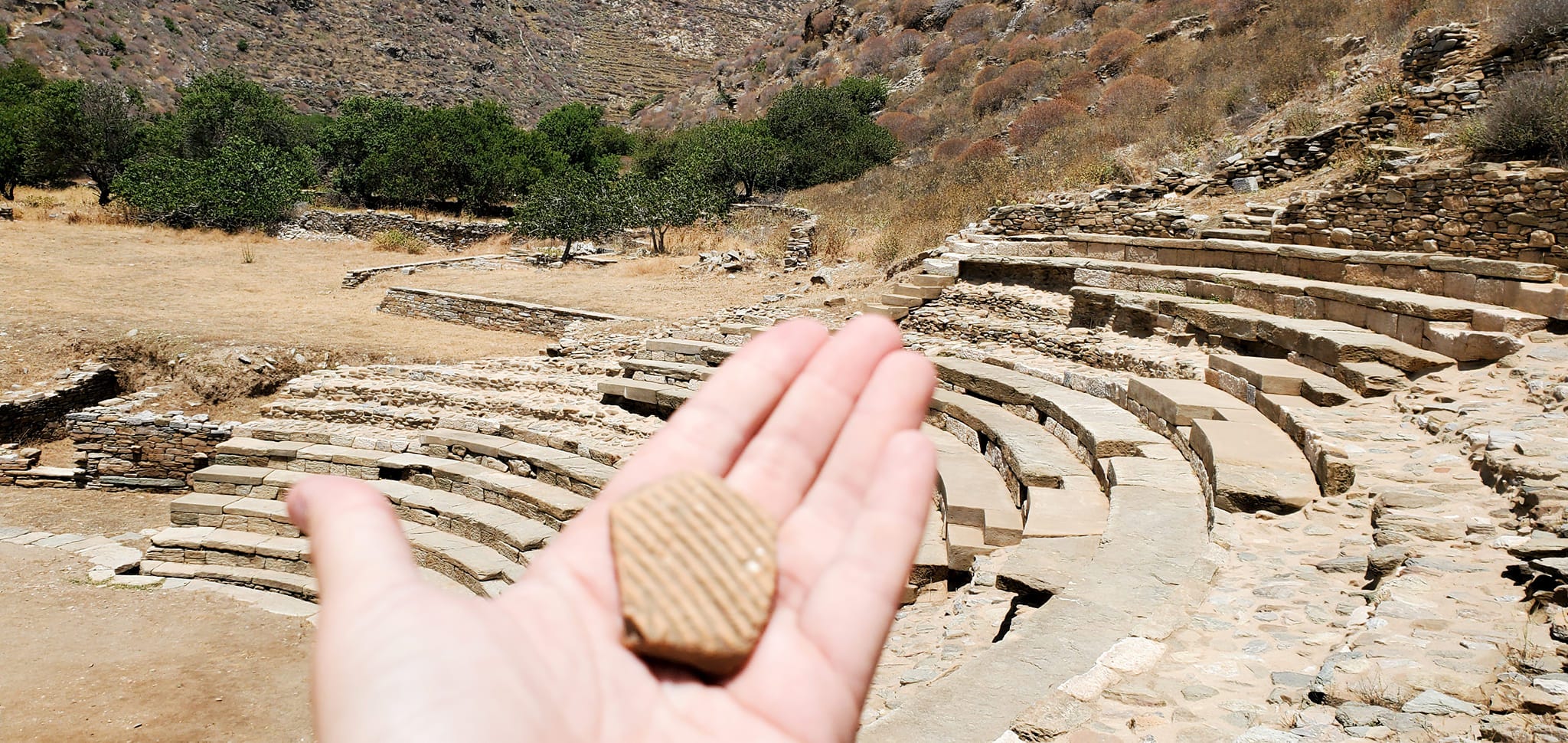
Now, it is the absolutely HIGHLIGHT OF MY LIFE when I get to visit these sites in person.
Even moreso when I get to take others (I host tours to places like this, by the way; you can click here to learn about upcoming trips you can join).
But learning doesn’t only look like this.
In fact, when I’m doing the deep work of reading, learning, and reflecting, it looks more like me sitting at my desk for hours… finally focusing on books and articles that I’ve been putting off because I’m tired from other work.
I actually just made an Instagram Reel about this.
Cal Newport even wrote a whole book on the concept of deep work, and his thesis statement is that “the ability to focus without distraction on a hard task is becoming rare and valuable, meaning people who build this skill will succeed.”
And that absolutely makes sense in the era of social media and short-form video (which, the irony is not lost on me that I’m creating content there and also somewhat adding to that).
But I’m also not an absolutist.
In order to do the deep work, I believe we also need to be human and have breaks, and enjoy what others have created (while also creating ourselves).
Then, when it’s time to lock in, we need to do that.
Whatever demands our focus and attention, should in theory be getting our full attention during that time.
When I’m traveling solo, I want my time, energy, and attention to be on the full enjoyment of that.
When I’m hosting others and traveling with them, making sure they’re enjoying and learning gets my focus.
And when I’m home alone, committed to reading or writing or even doing the boring and repetitive administrative tasks that keep everything running, that gets my full focus, too.
The Gatekeeping of the Ivory Tower
What do you think of when you hear the term ivory tower?
Before I define it (because we’re all historians here), I thought it would be interesting to share the history of the term.
It wasn’t always meant to say that someone is “out of touch,” or not in tune with the everyday demands of life for the common man.
The term ivory tower actually started as a compliment.
Its roots stretch back to the Biblical Song of Solomon (7:4), where it was used as a poetic metaphor for noble beauty and purity: “Thy neck is as a tower of ivory”.
By the Middle Ages, the term was absorbed into religious art and liturgy as a symbol for the Virgin Mary… representing a pristine, elevated sanctuary set apart from a chaotic world.

The pivot toward our modern understanding of the term happened in 1837, when French literary critic Charles Augustin Sainte-Beuve used the phrase tour d’ivoire to describe his contemporary, the poet Alfred de Vigny.
Sainte-Beuve contrasted Victor Hugo, who was politically active and out in the streets, with Vigny, who preferred to retreat into his "ivory tower" before noon to write away from the noise of common life.
By the 20th century, fueled by works like Henry James’s 1917 unfinished novel The Ivory Tower… the term fully lost its originally romantic and complimentary meaning.
It’s now evolved into a sharp critique of the intellectual elite… a symbol for institutions and academics so insulated by privilege, theory, and prestige that they’ve lost all touch with everyday practical reality.
And on one hand, it’s not a completely unfair indictment.
Even students complain of how a “fully funded Master’s” or a “fully funded PhD” leave a lot to be desired when it comes down to cost of living and what the modern world requires to just function.
But I think both meanings can be true at the same time.
Dedicated, sequestered time to learn and think truly is a privilege, and I’d argue it always has been.
So it only makes sense in academic specifically, that a unique culture and standard would emerge overtime that, either intentionally or unintentionally, excludes those it deems not meeting that standard.
I grew up in a trailer park in one of the poorest counties in southern California - close to the U.S./Mexico border.
Economic markers like poverty, fatherlessness, and lack of healthcare were so normal and rampant, that I didn’t even realize how poor I was - until I went to a community college 50 minutes north of me, in the greater Palm Springs area. What a contrast so close by! I lived in two different worlds everyday.
Music itself is inherently very exclusive, and the study of music traditionally has been very Western and Eurocentric (a topic for another time).
All of this to say, I still feel like I’m cosplaying whenever I get the chance to visit the Ivory Tower.
But I wasn’t raised with the taste and insider culture needed to really have a room there.
I’ve come to terms with being uncomfortable for the sake of growth - even to the point where I’ve learned to codeswitch (I’ve learned that you can’t have blonde hair, or a vocal fry - and be taken seriously) and dress the part when I absolutely need to.
My formal music training became “voice training” in more ways than one… showing me that certain parts of myself needed to be locked away and protected in its own sort of Ivory Tower, in order to pursue anything in academia, the arts, or the humanities.
This is not an endorsement of all this, by the way… nor is it me saying this is how things should be.
It’s moreso observations of what is.
I’d love to see more young adults in trailer parks reading Chaucer… and more inner cities learning languages before and after basketball games.
Ironically, we all have more access to knowledge than ever… but we’re spending less time learning and growing.
Another video and article for another time. ;)
The Rise of the Everyday Historian
If history (and the humanities as whole) are going to survive outside the quiet corridors of elite institutions, we have to burn down the idea that you need an invitation (or a tweed jacket) to participate in any of it.
The Everyday Historian isn’t about dumbing history down, or belitting the profession of a historian at all.
I want for us to tear down the aesthetic paywalls that keep people out.
It’s about the refusal to treat curiosity as a luxury good.
Here is what we actually stand for:
1. Curiosity Over Credentials
History doesn’t belong solely to the institutions that hoard or hold the manuscripts; it belongs to anyone willing to sit down and do the work of asking why.
You don’t need a degree from an Ivy League university or a desk at Oxford to hold a genuine, rigorous love for the past.
Passion and intellectual honesty matter infinitely more than your backdrop.
That said, if you have the opportunity to go to a wonderful institution like Harvard, Yale, Oxford, Stanford, etc? DO IT!!
2. The Beauty is in the B-Side (The Messy Reality)
We reject the sanitized, curated “Dark Academia” version of learning that only values pristine libraries and beautiful backdrops for field trips.
Real history happens in the messy middle:
Digging through dry primary texts at 1am
Reading dense texts at a clutter-covered desk
Chasing an obscure research rabbit-hole in your pajamas with a cold soda
The grind is the work.
And it’s allowed to look messy, boring, and completely unphotogenic.
3. Democratizing the Archives
For too long, history has been framed as something reserved for high-brow salons, distant experts, and people who “dress the part.”
But history is the ultimate human story; it’s about ordinary people navigating extraordinary worlds and all-too-familiar situations.
The moment we make history feel unapproachable, we rob people of their ability to understand where they came from, how their world was built and why we all are the way that we are.
4. Pure Passion
Whether you are analyzing major global migrations or harboring a hyper-specific, deeply niche love for the history of a single place like Red Mountain, your curiosity is valid.
You don’t have to justify what you love to learn about to fit someone else’s definition of “serious history.”
You Don’t Need to Be Anti-Aesthetics

The one downfall of social media (including Substack!!) is that it can enforce us to have really extremist views on things.
But I’m a woman of nuance.
I mean, if anything, being a student of history has made me that way!
So I’m not telling you that you can’t enjoy taking beautiful photos when you visit castles, or that you can’t have cute fall outfits on your Pinterest board.
I watch Gilmore Girls every year and it’s a joy to do so.
I suppose what I’m really calling for here is radical inclusion - to also mean the different socioeconomic classes and lifestyles that maybe don’t “fit the mold” of academia.
That anyone can be a student or a writer of history… and therefore, a historian.
Hiii, by the way - I’m Brittany.
@youreverydayhistorian on Instagram, Everyday Historian on YouTube, and host of the Facebook Group for people like us - everyday historians.
Thanks for being here and reading all the way down.
If you’d like for me to dive deeper into any of these topics, lemme know!